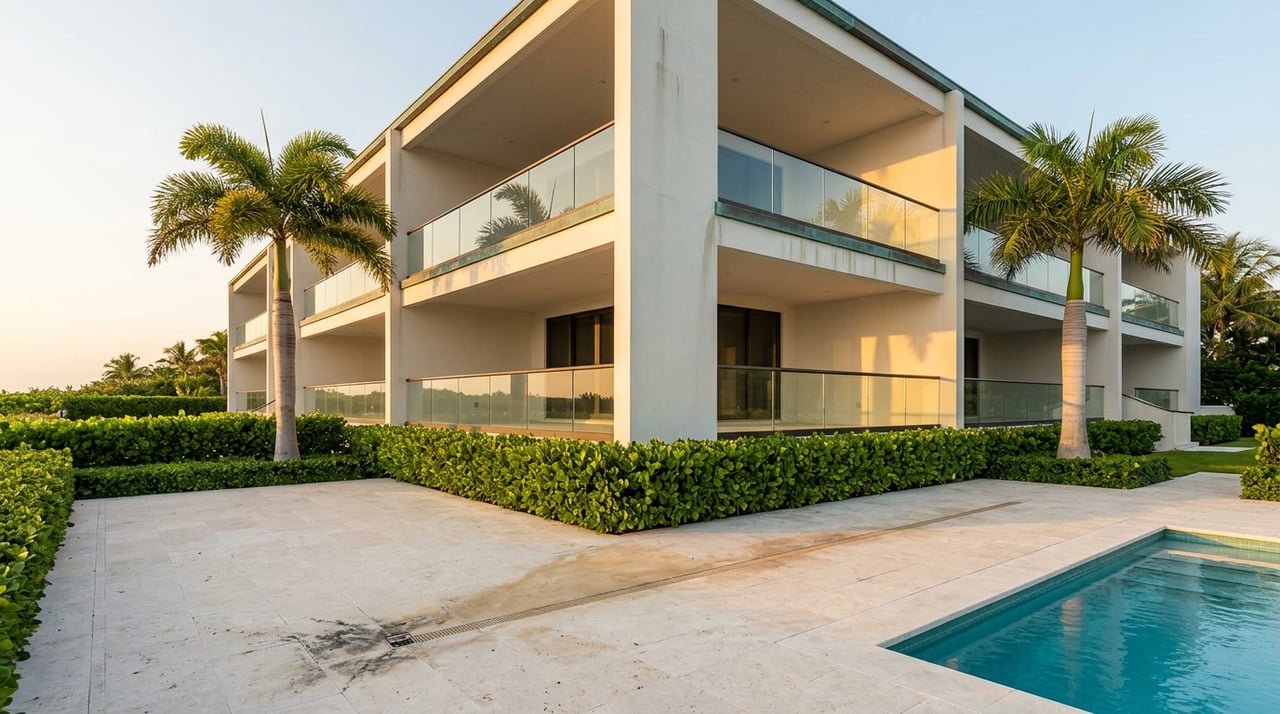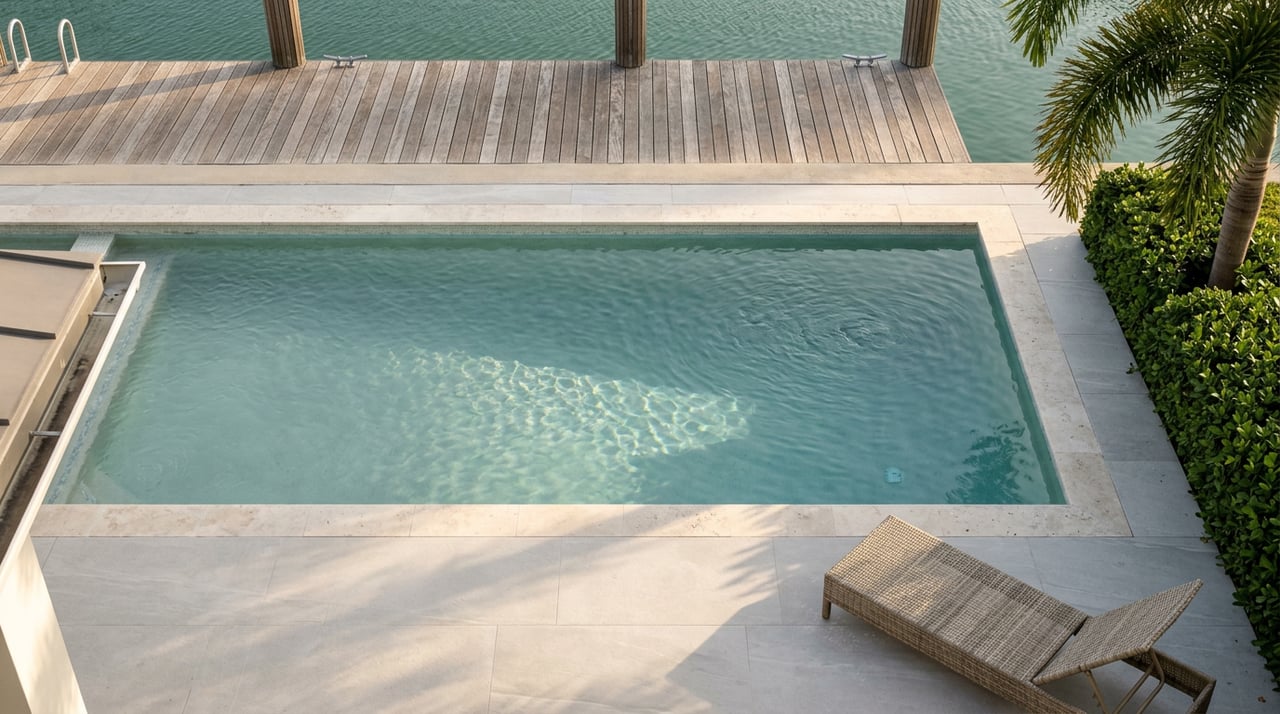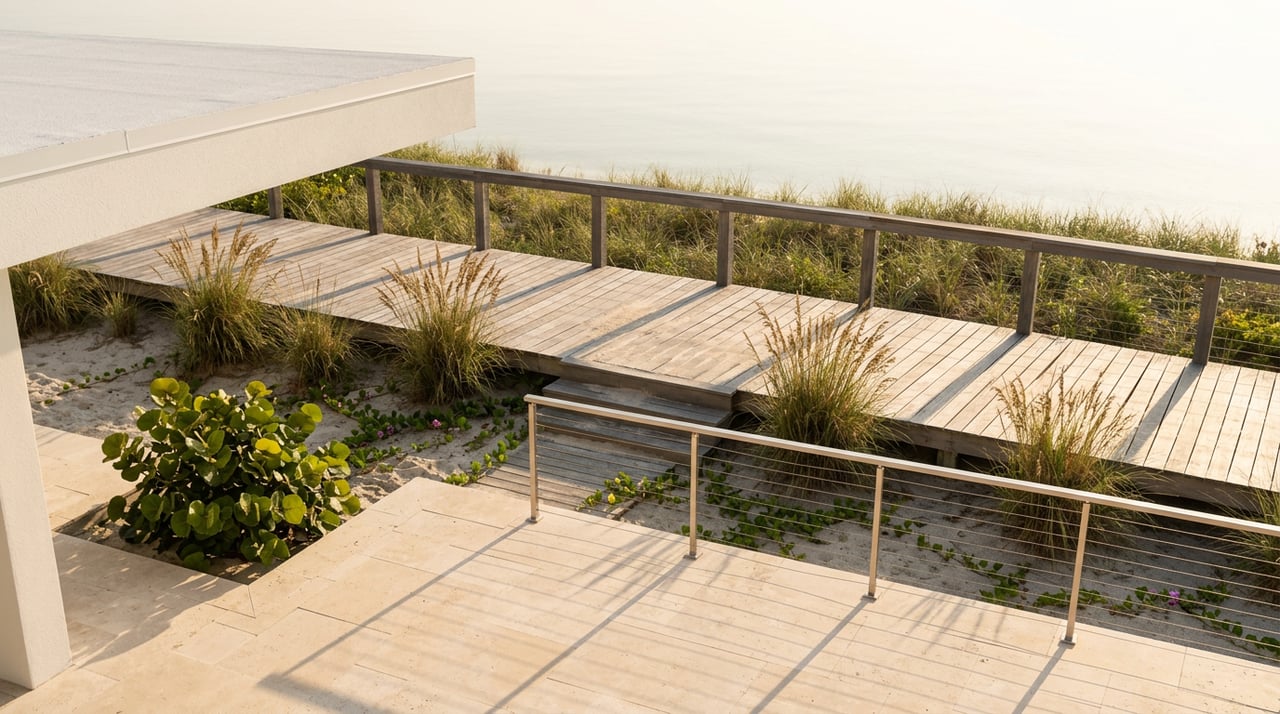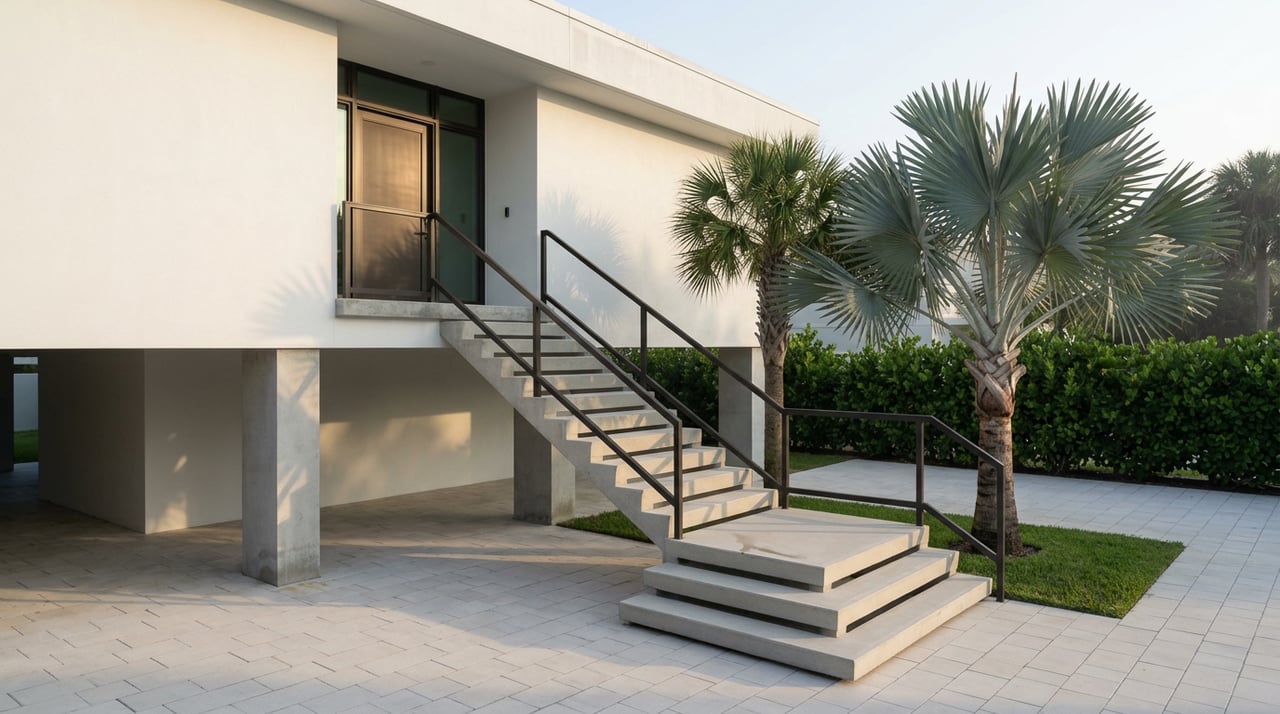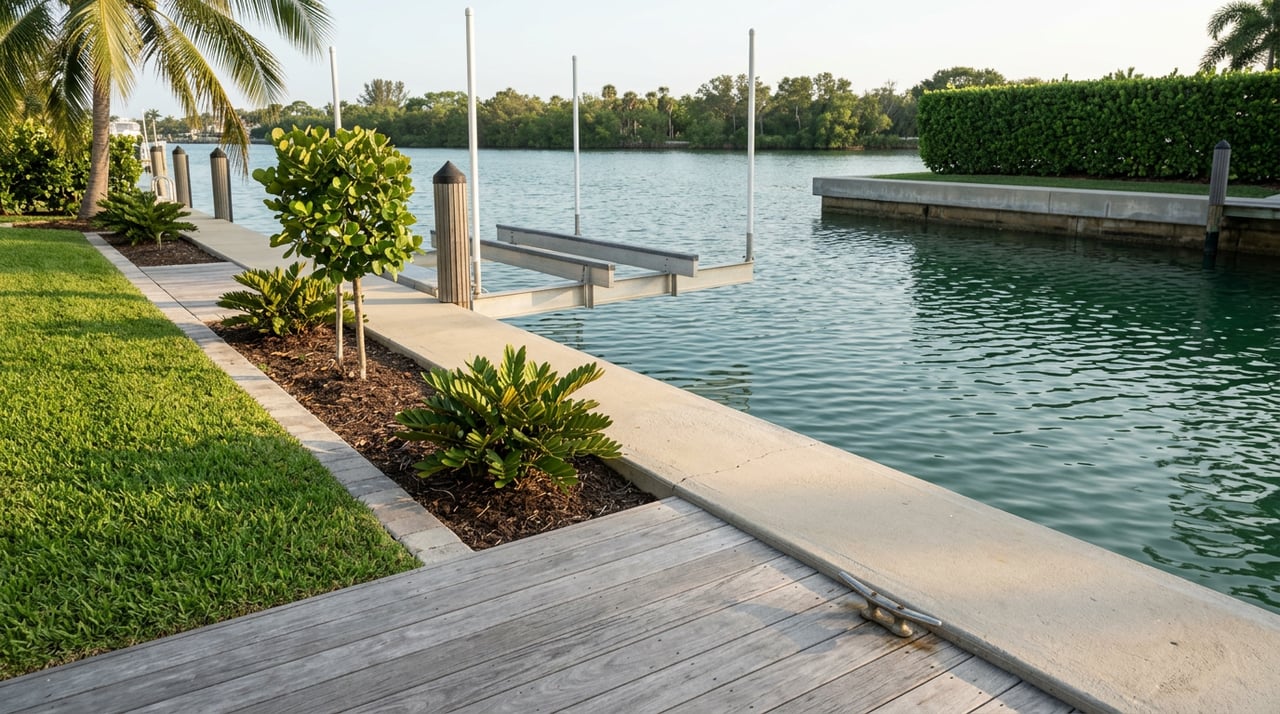
A buyer closes on a canal-front lot in Aqualane Shores, walks the dock for the first time as an owner, and checks the box mentally: flood insurance, done, covered. The wall holding back the canal and the dock the boat ties to are the two features that justified the price. Most buyers assume the flood policy they just bound protects both. It does not, and it was never designed to.
That gap is not a Naples quirk or a fine-print trick. A standard flood insurance policy, whether through the National Flood Insurance Program or a private carrier, insures the dwelling. It was built to pay out when rising water damages a structure people live in. Seawalls, bulkheads, and docks sit outside that scope by design. In most Florida canal neighborhoods this distinction barely matters, because the wall is decorative and the water is a view. In Aqualane Shores it matters more than almost anywhere else in Naples, because the wall and the dock are not decoration. They are the entire transaction.
Why the Wall Carries More Weight Here
Aqualane Shores was platted starting in 1949, with the first homes completed the following year, making it one of the earliest planned communities in a city that itself only incorporated that same year. The neighborhood's roughly 350 waterfront homes sit on a network of deep-water canals with no fixed bridges between the interior lots and Gordon Pass, which means a buyer here is paying for something more specific than square footage or a water view. They are paying for a boat's unobstructed route to the Gulf of Mexico, reachable from most docks in under fifteen minutes.
That access exists because of two physical structures: a seawall that holds the canal in place and a dock or lift that gets a vessel from the yard into the water. Neither one is optional in this neighborhood the way a pool or a summer kitchen is optional. Remove the dock and the address stops being a boater's address. Let the seawall fail and the yard behind it goes with it.
A neighborhood platted in 1949 has had three-quarters of a century for its original infrastructure to age out. Concrete and well-built vinyl seawalls generally hold up for 30 to 50 years with regular maintenance. Timber walls, more common on the earliest lots, tend to run a shorter 10 to 30 year service life. None of that maintenance math shows up on a flood insurance quote, because the quote was never asking the question.
What a Marine Permit Actually Touches
The City of Naples treats work at the waterline as its own regulatory category, separate from a building permit. A marine permit covers docks, boat lifts, pilings, seawalls, riprap, and dredging, and the city's own guidance is explicit that seawalls and revetments must be kept in good repair under its shoreline ordinance. Depending on the scope of the work, that review can trigger additional sign-off from the state and, for anything touching navigable water, the Army Corps of Engineers. Collier County's own marine permit portal lists docks, seawalls, boat lifts, and marine demolition as the categories that fall under this kind of review, which gives a sense of how wide the net is even before state or federal agencies get involved. A homeowner planning a straightforward dock repair can usually keep the process contained to one agency. A homeowner planning to replace a failing seawall, extend a dock, or add a boathouse is often looking at a longer, multi-agency runway.
Dock geometry is regulated locally, and the specifics matter more than buyers expect. Collier County's land development code, which sets the pattern for dock construction across the area's canals, caps a dock and its moored vessel at 25 percent of a waterway's width or 20 feet, whichever is less, on canals under 100 feet wide. The City of Naples, which Aqualane Shores rejoined in 1979 after a brief stint as its own incorporated city, administers a comparable dock and boathouse review through its own marine permit process, built on the same underlying logic: a structure sized to fit today's rules is not guaranteed to fit tomorrow's if it has to be substantially rebuilt. For a boathouse specifically, the county's code requires that the single-family home be built on the lot before or at the same time as the boathouse, a sequencing rule worth knowing for anyone buying vacant or under-improved waterfront with plans to build out slip infrastructure later.
Two Kinds of "Grandfathered," and Neither One Is Permanent
The word shows up constantly in Aqualane Shores listings and in insurance conversations, and it means two different things depending on who is using it.
The first is a zoning term. A dock, boathouse, or cut-in slip built before current setback and protrusion rules took effect can keep operating even though a brand-new version of the same structure would not be approved today. That protection travels with the structure, not the owner, and it disappears the moment the structure is substantially rebuilt or expanded. A buyer who sees "grandfathered cut-in slip" in a listing is looking at a structure that is legal today and would not be permittable if it needed to be rebuilt from scratch tomorrow.
The second is an insurance term. Some long-held flood policies in Naples still carry a grandfathered rating that predates current flood maps or FEMA's newer risk model. That grandfathering is being phased out as FEMA moves policies toward its Risk Rating 2.0 methodology, which prices a policy using the building's elevation relative to the base flood elevation alongside replacement cost, flood frequency, distance from water, and foundation type rather than the flood zone label alone. A legacy premium that looks attractive on a seller's disclosure is not guaranteed to survive a change in ownership or a lapse in coverage.
Neither grandfather clause is a permanent shield. Both are worth asking about explicitly, and both are easy to conflate if a buyer only hears the word once during a walkthrough.
The Pier Down the Street Is a Preview of the Timeline
Anyone who wants a real-world sense of how long marine work takes on this stretch of coast does not have to look far. The Naples Pier, a short walk from Aqualane Shores, lost roughly 460 feet of structure to Hurricane Ian on September 28, 2022, including about 140 feet that sank into the Gulf along with more than 30 pilings. The city's $26.3 million rebuild has moved through Florida Department of Environmental Protection review, a supplemental biological assessment, and Army Corps of Engineers sign-off, with FEMA obligating funding in December 2025. As of early August 2026, the pier remains under active construction, with the most recent public estimate putting full completion around July 2027.
That is a public project with a dedicated city team managing it, and it still took years to move through permitting and construction. A private seawall or dock project moves faster because it is smaller, but it answers to the same layered set of reviewers when the scope crosses certain thresholds. Buyers who assume a failing seawall is a weekend fix are usually assuming wrong.
What to Request Before You Waive Inspection
A buyer with real leverage during due diligence should ask for documentation that goes beyond the standard home inspection:
- A current seawall condition assessment, not just a visual walk-by
- Permit history for the dock, lift, and any seawall repairs, including confirmation of whether any structure is operating under grandfathered status
- The property's elevation certificate and its relationship to the base flood elevation
- A flood insurance quote run against the specific structure, not a neighborhood average, before any inspection contingency expires
- Written confirmation of who currently holds any grandfathered insurance rating and whether it is tied to continuous coverage
None of these documents are exotic. They are the same category of paperwork a buyer already expects for a roof or an HVAC system. The difference is that most buyers do not think to ask for the marine equivalent until after closing, when the answer costs money instead of a phone call.
Frequently Asked Questions
Does homeowners insurance cover the seawall if flood insurance does not? Generally no. Standard homeowners policies typically exclude water and earth movement damage to exterior structures like seawalls, treating them similarly to flood policies on this point. Coverage varies by carrier and policy form, which is exactly why a buyer should ask the specific question rather than assume.
How long does a dock or seawall permit take in Naples? Routine dock work often clears city review in a matter of weeks. A dock with a lift or a roof, or any seawall work that crosses into state or federal review, typically takes considerably longer, on the order of months rather than weeks.
If a seawall was built decades ago, does it have to meet today's code to be repaired? Repairs to an existing wall can sometimes proceed under the original scope, but once damage crosses into substantial structural failure, a full replacement is usually required, and a full replacement generally has to meet current code and current permitting review, not the standard the original wall was built to.
Can a new owner keep a seller's grandfathered flood insurance rating? Not automatically. Grandfathered ratings are tied to specific conditions and continuous coverage, and FEMA's shift toward Risk Rating 2.0 means fewer properties qualify for legacy treatment over time. This is a question to put to an insurance agent before the contingency period closes, not after.
Aqualane Shores rewards buyers who do the research a portal listing photo cannot show. If you are evaluating a canal-front property here and want a clear-eyed read on what a seawall, dock, or permit history actually means for your offer, Naples Coastal Living can walk the documentation with you before you waive a single contingency. Request a Private Market Update to start that conversation.